Berlin-Friedrichstrasse Railway Station
Cold war icon and onetime "hole" in the iron curtain.
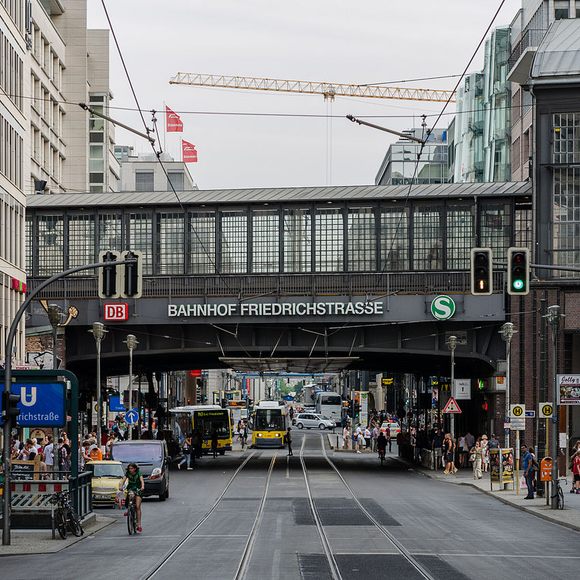
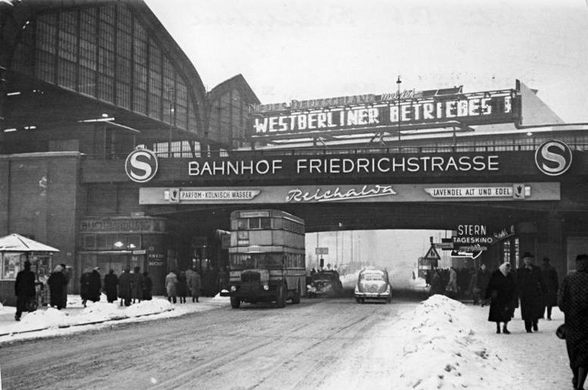

In 1945 Allied powers carved out their respective occupation sectors in Berlin, according to their own agenda, and with little regard to urban layout. The central district of Mitte, firmly in Soviet hands, became surrounded on three sides by West Berlin territory. When the Berlin Wall was erected in 1961 it cut through the very heart of the city, tearing through the public transportation network, and creating all sorts of anomalies.
Several underground lines which started off in West Berlin had to traverse East Berlin in order to reach their terminus stations. These trains were permitted to enter the East German territory but were not allowed to stop at intermediate stations, which become known as the Ghost Stations.
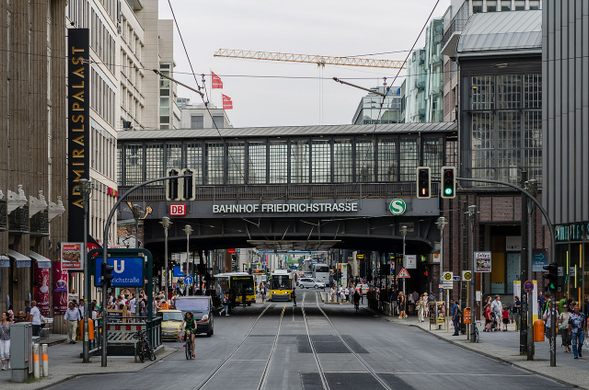
The Berlin-Friedrichstraße Railway Station became an even stranger anomaly. This station was a major transport hub in pre-war times, and the only place where several West Berlin lines running through East Berlin intersected on Soviet territory. Furthermore, the next station in the westward direction was across the Wall in the Western part of the city. Effectively the Berlin-Friedrichstraße Station was a hole in the Iron Curtain.
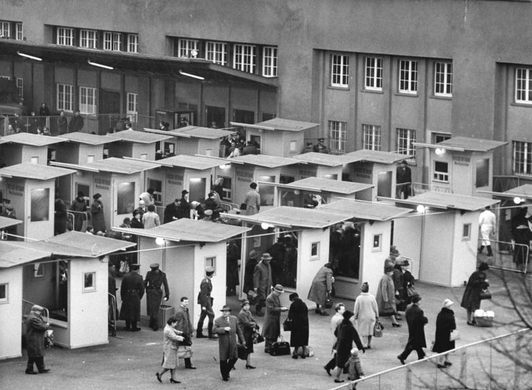
In order to patch it up the government of the German Democratic Republic created an elaborate maze of barriers and security checkpoints, separating the flow of East and West Berlin travelers every step of the way. It was a place of numerous escape attempts. The separate building created as a border crossing for West Berlin citizens become known as Tränenpalast (“Palace of Tears”) because of the emotional goodbyes that took place in front of it.
The East Germans also used an obscure service entrance to infiltrate its agents into the Western half of the city. The same passageway was used by members of the West-German communist party and the West-Berlin socialist party to pass without being checked or recorded. It was reportedly used as an escape route by members of notorious Red Army Faction to avoid arrest in West Germany and the station was also one of the stops on the route of the famous Paris-Moscow Express.
The barriers at Friedrichstraße Railway Station were one of the first to be removed after the fall of the Wall. The station today is still one of the busiest in Berlin.
Know Before You Go
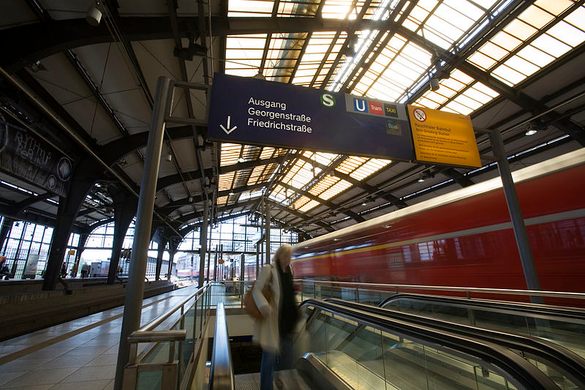
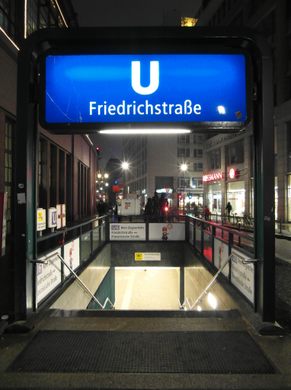
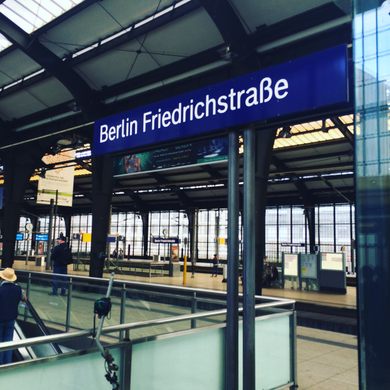
Friedrichstrasse Railway Station is serviced by S-Bahn lines S1, S2, S25, S3, S5, S7, S75 and U-Bahn line U6.


Plan Your Trip
The Atlas Obscura Podcast is Back!



Follow us on Twitter to get the latest on the world's hidden wonders.
Like us on Facebook to get the latest on the world's hidden wonders.
Follow us on Twitter Like us on Facebook